Since launch, Klaudius has targeted businesses with no website at all: build each one a bespoke site from its own photos and data, deploy it, pitch it. That stream isn't going anywhere — it's still the default, and still the cleanest pitch in local web work.
There's a whole other market alongside it, though: businesses that already have a website — a bad one. That covers a spectrum. At one end, sites that technically work but badly need replacing: they don't render properly on the phone every customer is holding, or they were visibly built a decade ago and left. At the other end, sites that have simply died: dead domains, hosting placeholders, security warnings. It's the expansion operators have asked us for more than any other; two of them put it to us independently, almost word for word.
As of this week, Klaudius targets them too. It's called Rescue mode, it ships as a free update to every licence, and this post covers what it targets, how it decides a site is genuinely bad (the interesting part), and what a live scan of one English town turned up.
The businesses everyone walks past
Here's the thing about a dead website: on the business's Google Business Profile, it looks exactly like a live one. A blue link that says "Website". Nobody clicks it — not the competitors scouting the area, not the agencies cold-emailing "I noticed you don't have a website" (they filter these businesses out, because the listing says they have one), and often not the owner, who paid someone for that site in 2016 and assumes it's still quietly doing its job.
Click it, and you find the whole taxonomy of web decay: domains that no longer resolve at all; domains that still resolve but serve a hosting company's "web space not ready" page; registrar parking pages; "account suspended" notices; certificates so broken that every visitor gets a full-page browser security warning; sites that render as a desktop-only postage stamp on the phone every customer is actually holding; sites with framesets, <font> tags and a copyright line from a decade ago.
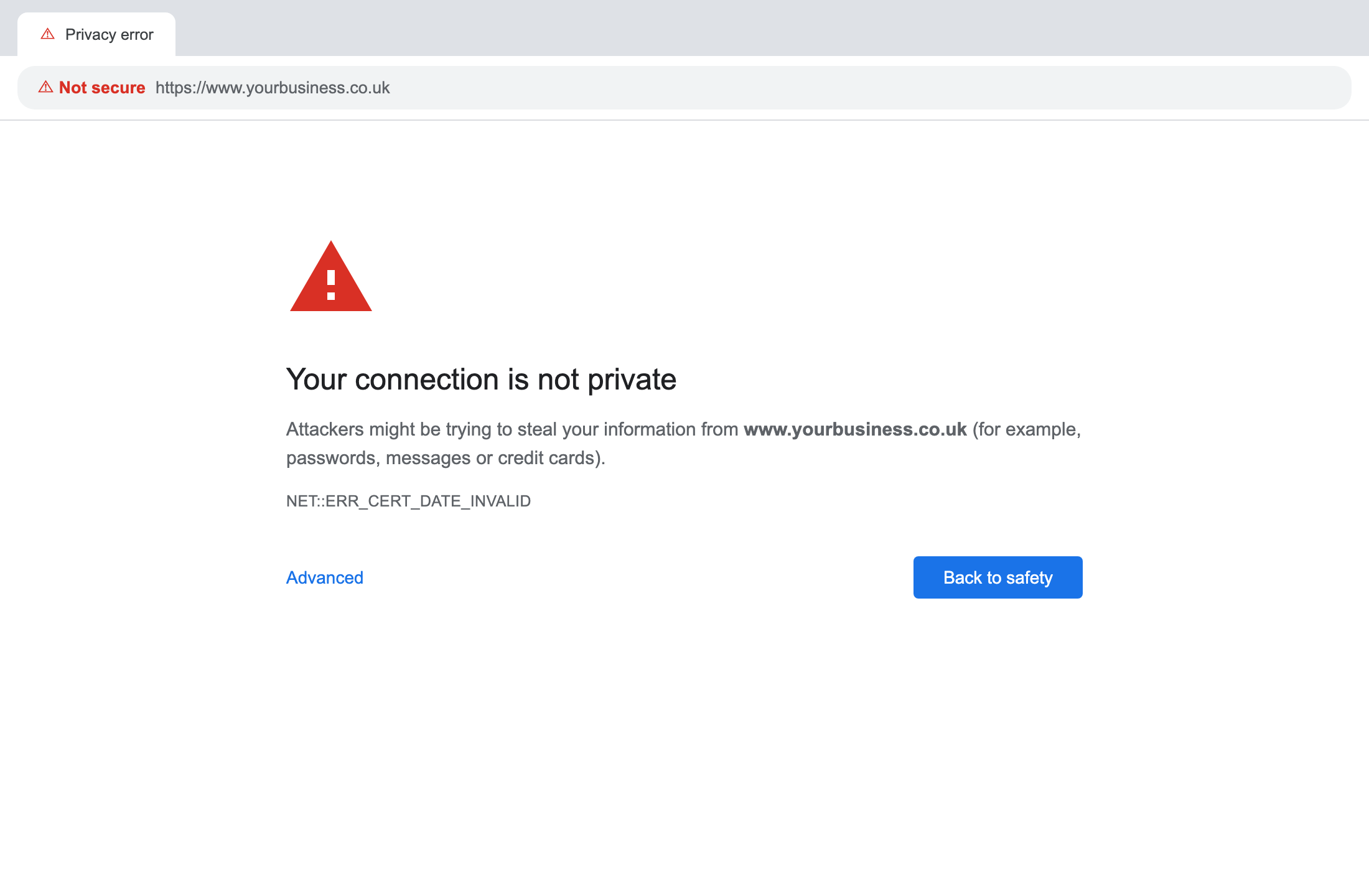
Every one of those businesses is telling you three things at once. They believed in having a website enough to pay for one. They stopped getting value from it, usually without knowing. And right now, every day, their Google listing is sending customers to an error page.
That's a better lead than a business with no website — because the hardest part of the no-website pitch, convincing someone a website matters, is already done. Their past self did it for you.
How Rescue mode decides a site is actually bad
This is where we spent the engineering effort, because the whole stream lives or dies on one rule: the pitch must never be wrong. If Klaudius tells an owner "your site doesn't load any more" and the owner opens it fine, that conversation is over — and so is your credibility in that town. So the qualification gate is deliberately conservative and mechanical: when the evidence isn't certain, the business simply isn't pitched.
Every candidate with a website gets its site fetched and classified. Here's a real verdict from the scan below, domain anonymised — this one still resolves, but serves a registrar's parking page over plain HTTP:
$ node scripts/site-check.js "http://yourbusiness.co.uk/"
{
 "url": "http://yourbusiness.co.uk/",
 "verdict": "bad",
 "signals": ["parked-or-suspended-page", "no-https"]
}
A lead qualifies only for verifiable, customer-visible failure:
- Dead: the domain no longer resolves, or the server actively refuses connections — confirmed on both the bare domain and the
www.variant before it counts. - Broken: a parking page, a hosting placeholder, a suspended-account notice, an HTTP error where a homepage should be, or a certificate failure (expired, self-signed, or issued for the wrong domain — the kind that makes every browser show "Your connection is not private" instead of the business).
- Visibly ancient or phone-hostile: no mobile layout at all, table-based or frameset markup, Flash, a years-old copyright line — in combination, never on a single signal.
Just as important is what doesn't qualify: a dated-but-working site. An owner with a functional site from 2019 has no compelled reason to switch, and pitching them spends your outreach on the hardest possible conversation. Borderline means no. And because sites do occasionally get fixed and certificates renewed, the check runs once more right before any message goes out — so the observation in the pitch is true at the moment it's sent, even for leads pitched days after they were found.
None of this needs anything from you. It's the same run the pipeline you already use — candidates with websites just flow through the gate automatically when the mode is on.
Nothing from the old site gets lost
One worry worth putting to bed directly: a rescue rebuild is never a downgrade of what the business already had. Before anything gets built, the pipeline walks the old site page by page and captures everything it publishes — not a summary, the lot. Every service and every price, exactly as listed. The owner's own wording on every page. Qualifications and accreditations. Their own photos, and the video their homepage leads with. Service areas. Email addresses and phone numbers. If the old site says it, the new site knows it — nothing is skimmed, paraphrased or left behind. The one exception is stock: photos and video clips supplied by whoever built the old site stay behind, because the business never owned them. Then it layers on everything the classic pipeline gathers anyway, from right across the business's public presence: their Google profile, reviews, photos, opening hours, their socials, directories and review platforms. The new site is built from the union of the two — every detail the old site carried, plus everything it should have had — so the owner recognises their business in it immediately, just presented the way it deserved to be. And when the old site is fully dead with nothing left to capture, the build runs on the same rich public-data gathering the classic stream has always used.
What one town's scan actually found
While building this we ran the stream across a single mid-size English town, one pass over the usual trades. The numbers are worth staring at:
- 107 businesses had a website link on their listing. The gate classified all of them.
- 11 qualified — roughly one in ten. The rest: 89 sites were fine (correctly left alone), 4 links pointed at directories rather than real sites, and 3 were ambiguous — which, per the rules above, means they don't count.
- Among the qualifiers: a 4.9★ builder with 39 Google reviews whose registered domain serves a hosting placeholder; a 33-review joinery whose domain no longer resolves; a 19-review locksmith, same story. Real, busy, well-reviewed businesses — with a dead front door.
Across the full scan, adding Rescue mode grew the town's pitchable leads by about 40% — 28 became 39. And the interesting part is where the growth came from: the established, higher-ticket trades. Every builder in that town already had a website (twenty out of twenty), and every locksmith too — which is precisely why that's where the new stream had the most to add. The town's single best rescue lead was one of those builders. The two streams complement each other: classic covers the businesses that never got a website, rescue covers the ones whose website didn't keep up.
The pitch writes itself (and stays honest)
Rescue leads use the same playbook that closes no-website leads: build the complete site first, lead with the finished thing. The message still opens with the gift — "I built you a new website, here it is" — with one addition: a single factual observation, drawn from what the gate actually recorded, in plain words. "Your current site at yourdomain.co.uk doesn't seem to load any more, so this one's ready to take its place." Or: "Your current site comes up with a security warning in the browser. This one won't."
No jargon, no audit, no shaming — one sentence the owner can verify themselves in five seconds. That verifiability is the entire trick. The no-website pitch asks an owner to imagine what they're missing; the rescue pitch invites them to click their own dead link.
Turning it on
If you're setting up fresh, the wizard now asks directly — "Also target businesses with a bad or dead existing website?" — one yes, done.
If you're already running Klaudius, ask your AI agent to update Klaudius, then tell it to enable Rescue mode. That's it.
Both streams blend in the same runs, the same CRM, the same follow-up cadence — a rescue lead is just a lead with a different opening line. Turn it off the same way any time; classic-only remains a perfectly good way to run.
Like the booking systems, the client CMS, and everything else since launch: if you own a licence, you already own this. That's the deal, and it doesn't change.