A business owner gets your pitch: a link to a finished website for their business, built before you've spoken. Many of them do the same thing next. Before they reply, they look you up.
What they find decides a lot. A studio with a site of its own, a face, a price and a way to get in touch reads as a real business. For an operator who's just starting out, that check is often the weakest link in the whole pitch, and until now it was the part Klaudius left to you.
Klaudius can now build your own website too: the site for your business, made the way it makes your clients' sites, from your real details. You see a private preview first, ask for any change in plain words, and when you're happy it goes live on your own domain.
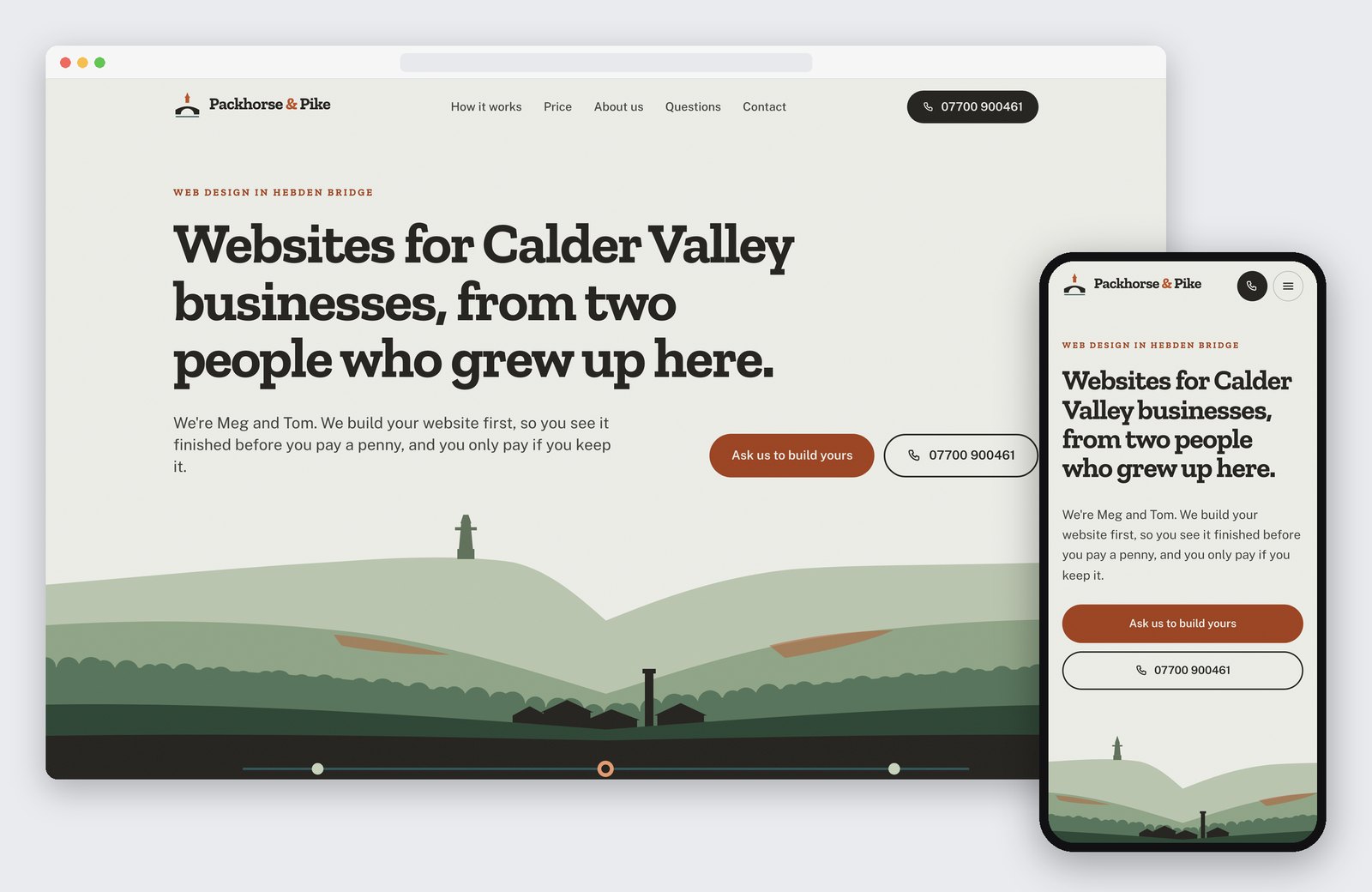
What it builds
One page that answers what an owner wants to know in the first ten seconds: that a real person is behind the message, what they build and where, what it costs, and how to get in touch. Around that, depending on what you give it:
- Your work. The client sites you've finished, each shown in a browser or phone frame and linked to the live site, with the business's name, trade and town.
- What it costs and what's included, with your add-ons in the owner's terms ("update your own text and photos", "customers book online") and their prices when you sell them at a set price.
- How it works. If you build first and the client pays only if they keep it, the page says so plainly, because it's the strongest thing a new studio can offer.
- About you, in your own words, with your photo.
- Questions owners actually ask, answered from your own details: the cost, what's included, the domain, the area you cover.
- A contact form, plus your email and, if you take calls, your phone number.
- A privacy page, and the legal notice your country requires a business website to carry, such as an Impressum in Germany or Austria.
It's written in your language and your voice, "I" for a one-person studio, "we" only when there's a team. It adds no analytics, trackers or cookies, so it needs no cookie banner.
The design is built around your strongest real asset, not a house style. With finished client sites to show, the work leads. With a good photo of you, you lead. With a niche, the page opens on that kind of business's problem in their words; with a town that has a character of its own, the place leads. A single simple price can be the headline. Two operators with different strengths get two different pages.
Nothing on it is made up
The quickest way to spot an agency page written by AI is the claims: "200+ happy clients", "a team of expert designers", "guaranteed page one of Google", a row of five-star reviews from people who don't exist. Each one is the opposite of what the page is for.
So the site states only what you've told it. Klaudius fills in what your install already knows (your price, your email, the add-ons you sell) and asks you once for the rest: your town and the area you cover, a few sentences about you, a photo, and which finished sites to show. Then:
- No numbers you didn't give it. No client counts, years trading or response times. The only count it may use is how many clients you've actually converted, once there are three or more.
- No testimonials you didn't send it, and those it uses are word for word, with the client's name and their OK.
- No portfolio without permission. A site only goes on once its owner is happy to be shown. A preview built for a business that didn't buy is a private draft, and it never appears.
- No team, office or awards you don't have, and no promises beyond what you actually offer.
- No mention of AI or Klaudius, unless you want one.
Starting with nothing to show
Many operators reading this haven't sold a site yet, and that's exactly when this matters most: your first pitch goes out before you have any work to point to. Build it anyway. With no portfolio, the page leads with what you do have: the offer itself (they see their website before they pay anything), you, your niche or your town. When the preview is ready, Klaudius tells you once, plainly, what would make the biggest difference: a photo of you, a phone number, and your own domain with an email address on it, so your pitch, your sender address and your site all carry the same name.
Your first client's site goes on the page as soon as they agree to be featured. Ask Klaudius to add them to your website and it captures their live site, frames it and puts it in your portfolio.
If you sell the AI receptionist
If you sell only the AI receptionist, your site sells that instead: the calls your clients miss today, what the receptionist does with them, and your monthly price. If you sell both, the receptionist sits with your other add-ons; if you sell each to different businesses, it gets a section of its own.
From preview to your own domain
The first version goes up at a private address, with search engines told to skip it, so you can look at it properly and ask for changes in plain words: "make the headline about plumbers", "use the other photo", "add my Instagram". When you're happy, say "put my website live on yourstudio.com".
The domain step is the easy one to get wrong, so Klaudius is careful with it. It checks what's on your domain now and asks before replacing a site that's already there. It changes only the website records, at the domain provider you already use, and never moves your domain's nameservers. If your email runs on the same domain, it keeps working. You get a short list of the records to add, and you can come back later and ask Klaudius to check your domain once they've taken effect.
Once your domain serves the site, it gets the same go-live search setup your clients' sites get: the structured data that tells Google and AI assistants what your business is, a sitemap, and a ping to the search engines. You also get a short checklist, including setting up a Google Business Profile as a service-area business, which puts your studio on Maps without showing a home address.
It goes on whichever host you use for your client sites.
Every enquiry becomes a lead
The contact form sends straight to your pipeline. Each enquiry becomes a lead in your database, you get an alert, and your next follow-up run puts it at the top of its report with an offer to draft your reply. If the person who wrote in is already in your pipeline (say, a business you pitched who looked you up and used the form), the enquiry joins their record instead of creating a duplicate. If they'd like to see a site for their business first, Klaudius can build one, so the enquiry turns into the same see-it-before-you-pay offer as everything else you sell.
Until your database is ready to take messages from a public page, the form opens a pre-filled email to you instead. Your own test messages through the form are recognised as tests, not leads.
Keeping it current
The site is edited in place, never rebuilt from scratch for a change. A new price, a new photo, a new town or a new testimonial is one request: ask Klaudius to update your website. When a client converts, it asks whether they're happy to be featured, so your portfolio grows with the work you actually do.
How to start
Ask Klaudius to "build my website". It's part of the standard pipeline: new subscribers have it out of the box, and if you're already running Klaudius, the app picks it up on its own.