Most businesses ring a new enquiry back when they get a moment. A painter up a ladder gets to it at lunchtime, and by then the person who filled in the form may have rung someone else.
You can now sell businesses a fix for that. Speed to lead is a new AI product, separate from the website and the AI receptionist. When someone fills in a business's enquiry form and asks for a call, its own AI assistant rings them within a minute or two. It says it's an AI, asks the questions that trade needs, then books them in or takes a message, and the owner hears straight away.
You can pitch it to new businesses, on its own or with a website, and your pitch lets the owner try it on their own form. Already have clients? Sell it to them too. It's part of your Klaudius plan. Here's how you pitch it, what the business gets, what you set up and what it costs to run.
How you pitch it: the owner tries it on their own form
You can pitch speed to lead to businesses you haven't worked with yet in two ways: with the website Klaudius builds them, or on its own.
With a website: the site you built rings the owner
When Klaudius builds a business a website, the pitch adds one sentence: fill in the contact form on your new site with your mobile, and see what happens.
The owner puts their mobile in the form, confirms the number and agrees to one demo call from you. Their phone rings. The AI says it's a demo from you and that their business isn't involved, then plays what an enquiry line for their business could sound like: it asks that trade's questions and offers two example times. It ends by saying that in the real version, they'd get the details of the call straight away.
Nothing is booked, and the AI won't talk prices or offers. The owner has just heard what every enquiry to their business could get.
You set the demo up once for each country you pitch in: a demo number in your own name, your business details, your own privacy page (Klaudius gives you the wording) and the demo's wording, which you read and approve once. After that, that number covers every business you pitch there, and Klaudius adds the form to each preview site and the sentence to each pitch by itself. It rings only for a business you've pitched in the last 14 days that isn't a client yet, once per number a day, and within a daily limit you set.
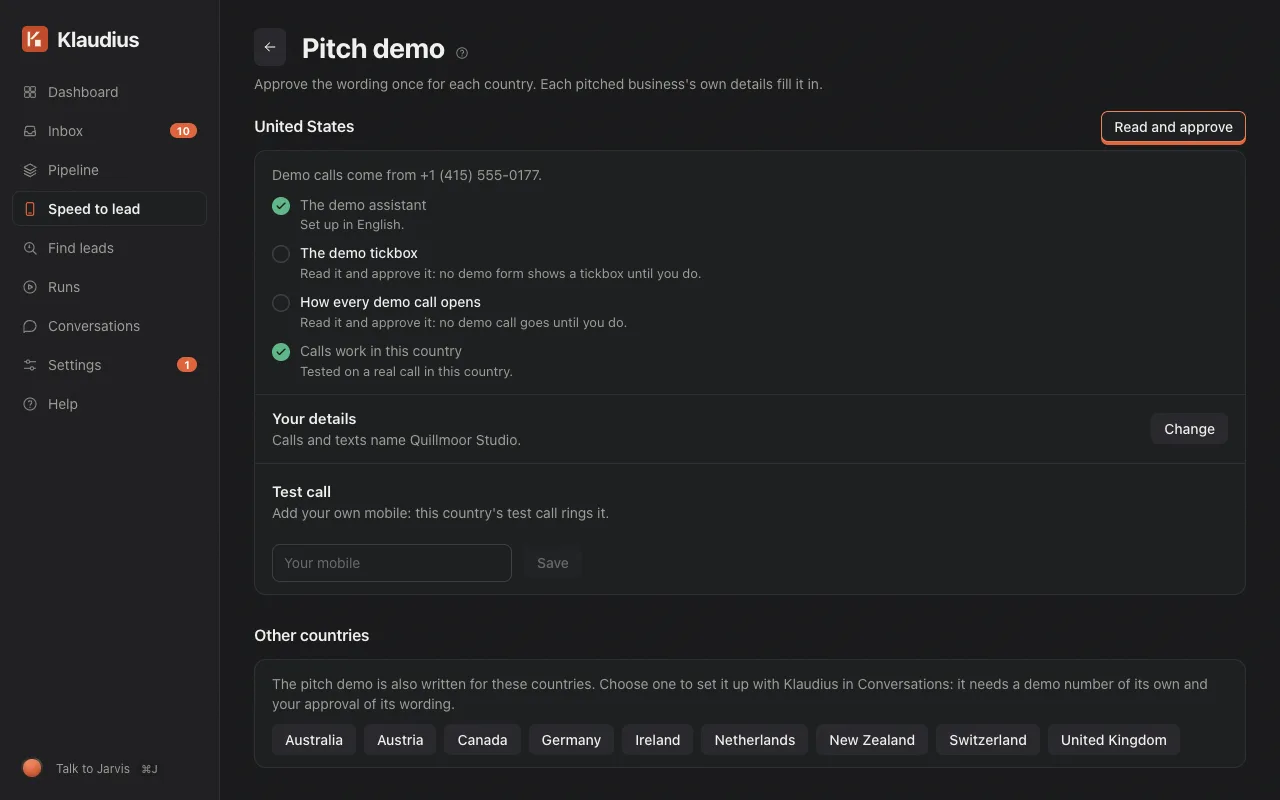
The pitch demo runs in the same countries as client calls: the US, the UK, Ireland, Australia, New Zealand, Canada (outside Quebec), the Netherlands, Germany, Austria and Switzerland. In the US it runs in 29 states, and in Texas, Arizona, Ohio and Pennsylvania once you've recorded your own telemarketing registration there. A few countries ask you for more, such as your own National Do Not Call List registration in Canada or a KvK trade name in the Netherlands, and Klaudius takes you through it.
On its own: a demo page with the business's form
Plenty of businesses already have a website with a quote form. Klaudius can pitch them speed to lead by itself. It looks for businesses whose own site has an enquiry or quote form and whose work is quoted, such as trades and home services, and leaves out health businesses and ones a booking page serves better, like salons and restaurants. Each business gets a small demo page with its name and the form, and the pitch invites the owner to put their mobile in. From there, it's the same demo call.
You can also have Klaudius work both from one search: a business with a good website and a form gets the speed-to-lead pitch, and one without gets a website pitch. Ask Klaudius to pitch speed to lead on its own, or both.
What the business gets
- Someone fills in the enquiry form. On a site you built, Klaudius adds the form and its consent page. For a business with a website you didn't build, you get a link for its quote or contact button, or a form to drop into the page.
- They ask for the call. They confirm their mobile with a texted code and agree to a call from the business's AI assistant. In some countries they're sent a text first, and the call follows their reply.
- Their phone rings within a minute or two, from the client's own local number, during calling hours. Outside them, the call waits for the next opening.
- The AI handles the first conversation. It asks the two or three questions that trade needs, then books them in or takes a message. It never quotes a price or takes a payment.
- The owner hears straight away, by text or email, with what the person needs and any time they chose.
Every enquiry is kept in your own database, so you can ask Klaudius for a monthly summary for each client: how many enquiries came in, how fast each was contacted and how many booked.
Bookings, the way each business takes them
You choose how each client takes bookings:
- The booking page on its own website. If you've added a Klaudius booking system for appointments, calls book straight into it.
- Cal.com. Calls book into the client's Cal.com event.
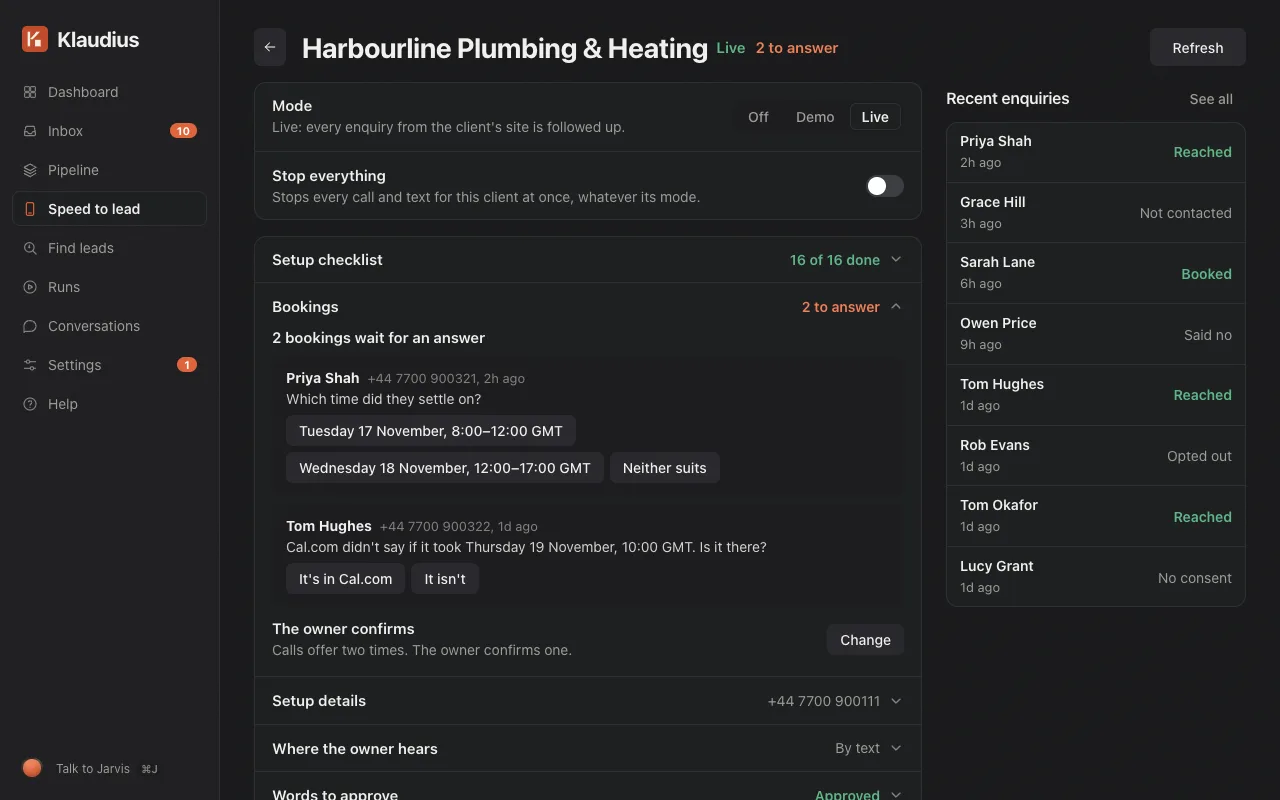
- The owner confirms. The AI offers two times from the owner's hours, and the owner confirms one by text, or tells you and you confirm it in the app.
- Take a message. The AI asks its questions and says the business will call back, and the owner gets the message.
What every call does
The opening is set by the rules for where that person is, and it can't be edited out. It says it's an AI assistant, who it's calling for and how to stop. In the US and Canada it also names a real person, usually the owner, who has agreed to it.
The person's words are turned into text as they speak, so the AI can answer, but no transcript is kept and their voice isn't recorded. In the US, the UK, Australia and New Zealand, and in Canada if the person agrees, the AI's own words in the opening can be recorded, as proof of what it said. The owner gets a short summary of the call.
Anyone who says stop on a call, replies STOP to a text or uses the client's stop page isn't contacted by that business again, on any channel, unless they ask it to.
Before every call, Klaudius checks the rules it holds for where the person is: the calling hours in their local time, how many tries and how far apart, the consent they gave and any opt-out. A lead those rules refuse isn't called, and the owner gets an alert to ring them. Klaudius applies those rules and doesn't vouch for anyone, so whether a client's use is lawful is for you and the client to check.
Where it works
A client's AI assistant calls in the US, the UK, Ireland, Australia, New Zealand, Canada (outside Quebec), the Netherlands, Germany, Austria and Switzerland. In the US it goes state by state, and a lead in a state it doesn't call goes to the owner to ring. Outside the US, there are no AI calls for health businesses, and in some countries none for financial, insurance or legal ones either.
What you set up
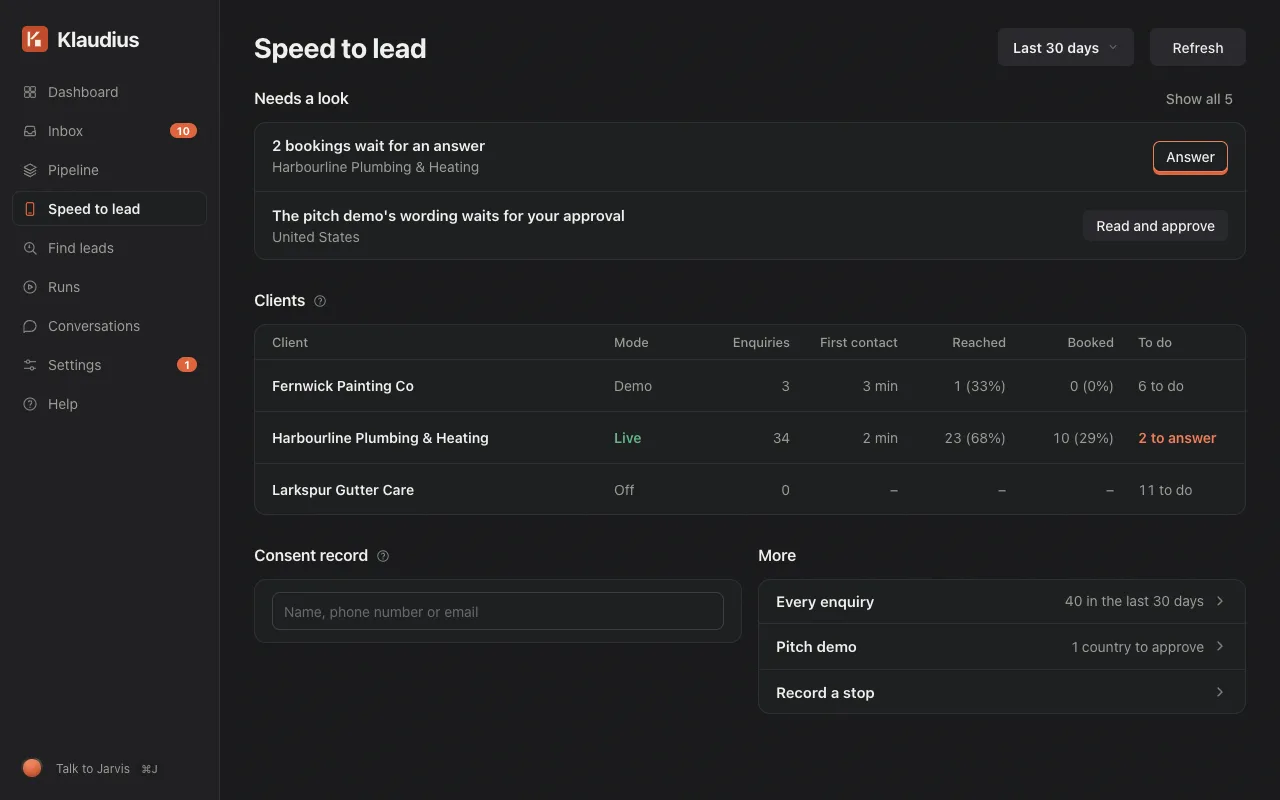
To start pitching it, ask Klaudius to set up the pitch demo, as above. Once a business signs, ask Klaudius to set up speed to lead for it, or pick it under Add-ons for your clients on the Runs page. It works through the client's details, a local number on your voice platform account (it asks before buying one), the AI's questions and the form. Two things are yours to do. You read and approve every consent text and call opening, word for word, and you make the owner's test call, so their phone rings from the AI as a customer's would. Nothing goes live until both are done.
After that, each client is off, in demo or live, and you can stop every call and text for one client at once, calls under way included. The Speed to lead screen shows what needs you, such as a booking waiting for the owner's answer, and how each client's enquiries went.
What it costs to run
Speed to lead is part of your Klaudius plan. The calls and texts run on a prepaid voice platform account of your own, which you pay directly, and Klaudius adds nothing on top.
- Pitching it: one demo number in each country you pitch in covers every business you pitch there. A US number is about $1–2 a month, and a US demo call costs up to about 20 cents a minute (up to about 40 cents for a two-minute call), plus a few cents for its texted code. Calls and texts in some countries cost more.
- A client's live service: its own number, about $1–2 a month in the US, and up to about 20 cents a minute for its US calls, with codes and texts on top.
You set the client's monthly fee.
Already have clients? Sell it to them too
If you've already sold businesses a website, they're a warm place to sell speed to lead too. The pitch can be one message:
"Quick one: when someone fills in the form on your site, how long before they hear from you? I can set it up so they get a call from your number within a minute or two, during your calling hours, from an AI assistant that says it's an AI, asks your usual questions, books them in and tells you straight away. Want to try it on your own phone first?"
"Your own phone" is the close. The owner's test call rings them from the AI, as a customer's would.
The bigger picture
The AI receptionist answers the calls a business misses. Speed to lead rings back the people who fill in its enquiry form. Sold together, they're an AI front desk for that business, and you set the monthly fee for each.
Speed to lead is in the Klaudius app. If you're already running Klaudius, the app picks it up by itself: ask Klaudius to set up the pitch demo, or to set up speed to lead for a client you already have.